
Train World Records are really records of engineering ambition. Every time a railway becomes faster, longer, heavier, higher, or more powerful, engineers are testing how far steel, electricity, traction, aerodynamics, infrastructure, and human coordination can be pushed.
At Joshi’s Museum of Miniature Railways, or JMMR, these are exactly the stories that make trains endlessly fascinating to us. Our museum works at a very different scale, where entire railway worlds fit inside a room, but the questions remain remarkably similar. How do you control movement? How much power do you need? How do wheels maintain traction? How do hundreds of railway components work as one system?
From a French train travelling at more than 570 km/h to an Australian freight train stretching over seven kilometres, here are some of the most incredible Train World Records currently recognised across global railway history.
| Railway Record | Train / Railway | Record |
| Fastest conventional train test | TGV V150, France | 574.8 km/h |
| Fastest unmodified production passenger train | CRH380BL, China | 487.3 km/h |
| Fastest maglev in regular public service | Shanghai Maglev | 431 km/h |
| Longest freight train | BHP Iron Ore, Australia | 7.353 km |
| Longest passenger train | Rhaetian Railway, Switzerland | 1.91 km |
| Highest railway station | Tanggula, Tibet | 5,068 m |
| Longest journey without changing trains | Moscow to Pyongyang | 10,214 km |
| Most powerful steam locomotive currently operating | Union Pacific Big Boy 4014 | 135,375 lbf tractive effort |
Records can be reclassified or broken over time, so the distinctions between test trains, production trains, and regular passenger services matter.
Ask someone for the fastest train in the world, and the answer depends on exactly what kind of record you mean.
For conventional steel-wheel railway technology, one of the most famous records belongs to France’s TGV V150. On 3 April 2007, the specially modified train reached 574.8 km/h on the LGV Est high-speed line. The train and infrastructure were prepared specifically for the attempt, which is why it should not be confused with normal passenger operation.
Why is travelling at nearly 575 km/h so difficult?
As speed rises, aerodynamic drag becomes a much bigger enemy. The train needs enormous power not simply to accelerate, but to push air out of its way. Track geometry, overhead electrical supply, wheel stability, vibration, and braking also become increasingly critical.
China holds another fascinating speed distinction. A production CRH380BL reached 487.3 km/h during a test between Beijing and Shanghai in January 2011. Guinness recognises this as the fastest speed reached by an unmodified production passenger train.
So even within one record category, there are different engineering questions: How fast can a specially prepared train go? How fast can a production train go? And how fast should trains realistically operate every day?
Then there is maglev.
The Shanghai Maglev has reached 431 km/h in regular public service. Instead of relying on conventional wheels rolling on rails, magnetic levitation uses electromagnetism to lift the train above its guideway. With almost no physical contact between vehicle and guideway at speed, rolling friction is dramatically reduced.
That does not mean resistance disappears. Air resistance still becomes enormous at high speeds. But removing conventional wheel-to-rail contact changes what is mechanically possible.
This is what makes Train World Records so interesting. Every record usually comes from engineers attacking a different limitation.
For the TGV, it is conventional rail speed.
For maglev, it is reducing contact friction.
For freight railways, the challenge becomes something entirely different: pulling incredible amounts of mass.
On 21 June 2001, BHP Iron Ore operated a train in Western Australia that seems almost absurd when written down.
It was 7.353 kilometres long.
The train consisted of 682 ore cars, eight General Electric AC6000CW diesel-electric locomotives, and a total of 5,648 wheels. It weighed 99,732.1 metric tonnes, making the same operation both the longest and heaviest freight train recognised by Guinness.
But the most interesting fact is not its length.
It is how the train was controlled.
The eight locomotives were distributed through the enormous rake, with some engines separated by nearly a kilometre. A train-control system allowed the driver at the front to command the other locomotives together.
This is called distributed power, and it solves a fundamental problem. If all the pulling force came only from the front, the mechanical stresses through such a long train could become enormous. Placing locomotives throughout the consist helps distribute traction and braking forces.
Suddenly a world record becomes a lesson in systems engineering.
Freight trains are expected to be enormous. A 1.91 kilometre passenger train travelling through the Swiss Alps is another matter entirely.
On 29 October 2022, the Rhaetian Railway operated what it describes as the world’s longest passenger train on its UNESCO World Heritage Albula Line.
The numbers were remarkable:
The train stretched for almost two kilometres as it travelled through one of Switzerland’s most spectacular railway landscapes.
Coordination was the real achievement. Seven drivers had to operate different sections of the train in synchronisation, while engineers managed braking, communication, couplings, gradients, and tight Alpine curves.
At JMMR, Switzerland already has a special place in our railway world through our Swiss Jungfrau Static Model, inspired by another extraordinary Alpine railway that climbs to Jungfraujoch at 3,454 metres.
Love Swiss railway engineering? Explore our Swiss Jungfrau model and discover how one of Europe’s great mountain rail stories has been recreated in miniature at JMMR.
Speed and length test machines. Altitude tests almost everything.
Tanggula Railway Station on the Qinghai-Tibet Railway sits at 5,068 metres above sea level, making it the world’s highest railway station according to Guinness World Records. The station opened in 2006.
At that height, there is much less oxygen in the atmosphere. Temperatures can become extreme, and large sections of the railway pass through frozen ground and permafrost.
The Qinghai-Tibet Railway therefore required much more than simply laying tracks uphill. Passenger coaches were designed with features including enriched-oxygen systems and ultraviolet protection for high-altitude travel.
This illustrates an important principle of railway engineering: a train can only be as successful as the infrastructure and environment around it allow.
Tracks, foundations, signalling, passenger comfort, propulsion, weather protection, and maintenance all become part of the railway system.
Some railway records are about technology racing forward. Others remind us how extraordinary older engineering already was.
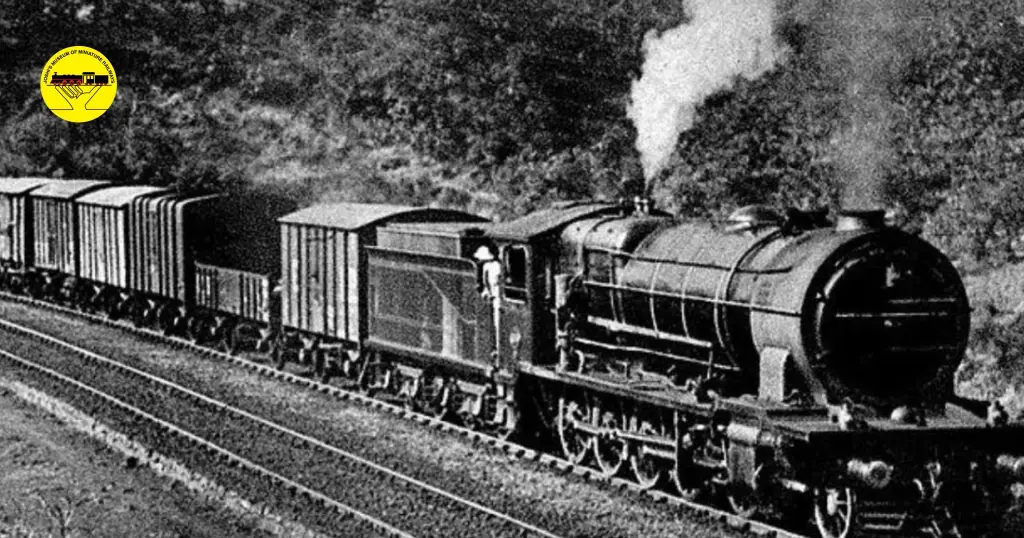
Union Pacific’s Big Boy No. 4014 is recognised by Guinness as the most powerful steam locomotive currently in operation. It can produce 135,375 pounds-force of tractive effort, equivalent to around 602 kN.
Built in 1941, Big Boy 4014 belongs to the enormous 4-8-8-4 articulated locomotive class designed to haul heavy freight across the demanding Wasatch Range in the United States.
The locomotive itself weighs approximately 691 tonnes, before adding its tender. Twenty-five Big Boys were originally built between 1941 and 1944. No. 4014 eventually spent decades as a static museum exhibit before being restored to operation in 2019.
Its dimensions help explain why steam locomotives continue to fascinate model railway enthusiasts. A steam engine exposes its engineering visually. Rods move. Wheels turn. Steam expands. Mechanical forces are almost theatrical.
At JMMR, steam trains remain an important part of the miniature railway story precisely because they make engineering so wonderfully visible. Our Pune layout includes steam, diesel, high-speed intercity, underground, funicular, and other railway forms within one miniature world.
Not every railway record is about machinery. Some are about the extraordinary distances railways can connect.
Guinness lists a 10,214 km journey from Moscow to Pyongyang as the world’s longest train journey without changing trains. The route uses sections of the famous Trans-Siberian Railway and is scheduled to take approximately 7 days, 20 hours and 25 minutes.
Think about what that means.
One train journey crosses thousands of kilometres, climates, landscapes, settlements, borders, and time zones.
This is perhaps the most human of all these records. It reminds us that railways are not remarkable simply because the machines are powerful. They are remarkable because they connect places that would otherwise feel impossibly far apart.
The spectacular numbers attract attention, but the engineering behind them is what makes these records worth remembering.
Every record solves a different problem:
| Record Type | Engineering Challenge |
| Extreme speed | Aerodynamics, stability, braking, power |
| Extreme train length | Communication and distributed control |
| Extreme weight | Traction and structural forces |
| High altitude | Climate, oxygen, permafrost, infrastructure |
| Steam power | Boiler capacity, adhesion, mechanical traction |
| Long-distance operation | Reliability, scheduling and railway coordination |
This is also why railway modelling remains such a rich hobby.
At Joshi’s Museum of Miniature Railways, Bhau Joshi believed railway modelling could encourage future engineers and scientists because the hobby brings together architecture, civil engineering, electrical engineering, computer engineering, physics, mathematics, photography, and many other disciplines.
A world-record railway may stretch thousands of kilometres.
Our railway may fit inside a museum hall.
But both depend on the same fascination with systems, precision, movement, and problem-solving.
Discover the story behind JMMR and why we continue to preserve railway modelling as a hobby, educational tool, and engineering passion for future generations.
Train World Records fascinate us because railways are already extraordinary machines, and records reveal what happens when engineers refuse to accept their apparent limits.
A train travels at 574.8 km/h while still using steel wheels.
Another stretches for more than seven kilometres.
A railway climbs above 5,000 metres.
A steam locomotive built in 1941 returns to operation almost eight decades later.
Each achievement begins with the same question that sits at the heart of engineering: Can this be done?
At Joshi’s Museum of Miniature Railways, we may explore railway engineering from the opposite end of the size spectrum, but the fascination is exactly the same. Whether a railway stretches across a continent or fits inside one room, it remains a remarkable story of movement, precision, imagination, and human ingenuity.
1. What is the fastest train in the world?
The modified French TGV V150 reached 574.8 km/h in 2007, one of the highest speeds ever achieved by a conventional wheel-on-rail train. The record is different from normal passenger-service speeds.
2. What is the longest train ever recorded?
BHP Iron Ore operated a 7.353 km-long freight train in Western Australia in 2001. It consisted of 682 ore cars and eight locomotives.
3. What is the longest passenger train in the world?
Rhaetian Railway operated a 1.91 km passenger train in Switzerland in October 2022 using 25 four-part Capricorn trainsets, creating a 100-carriage formation.
4. What is the highest railway station in the world?
Tanggula Railway Station in Tibet is recognised at 5,068 metres above sea level.
5. What is the most powerful steam locomotive still operating?
Union Pacific Big Boy No. 4014 is recognised as the most powerful steam locomotive currently operating, with tractive effort of 135,375 lbf.