
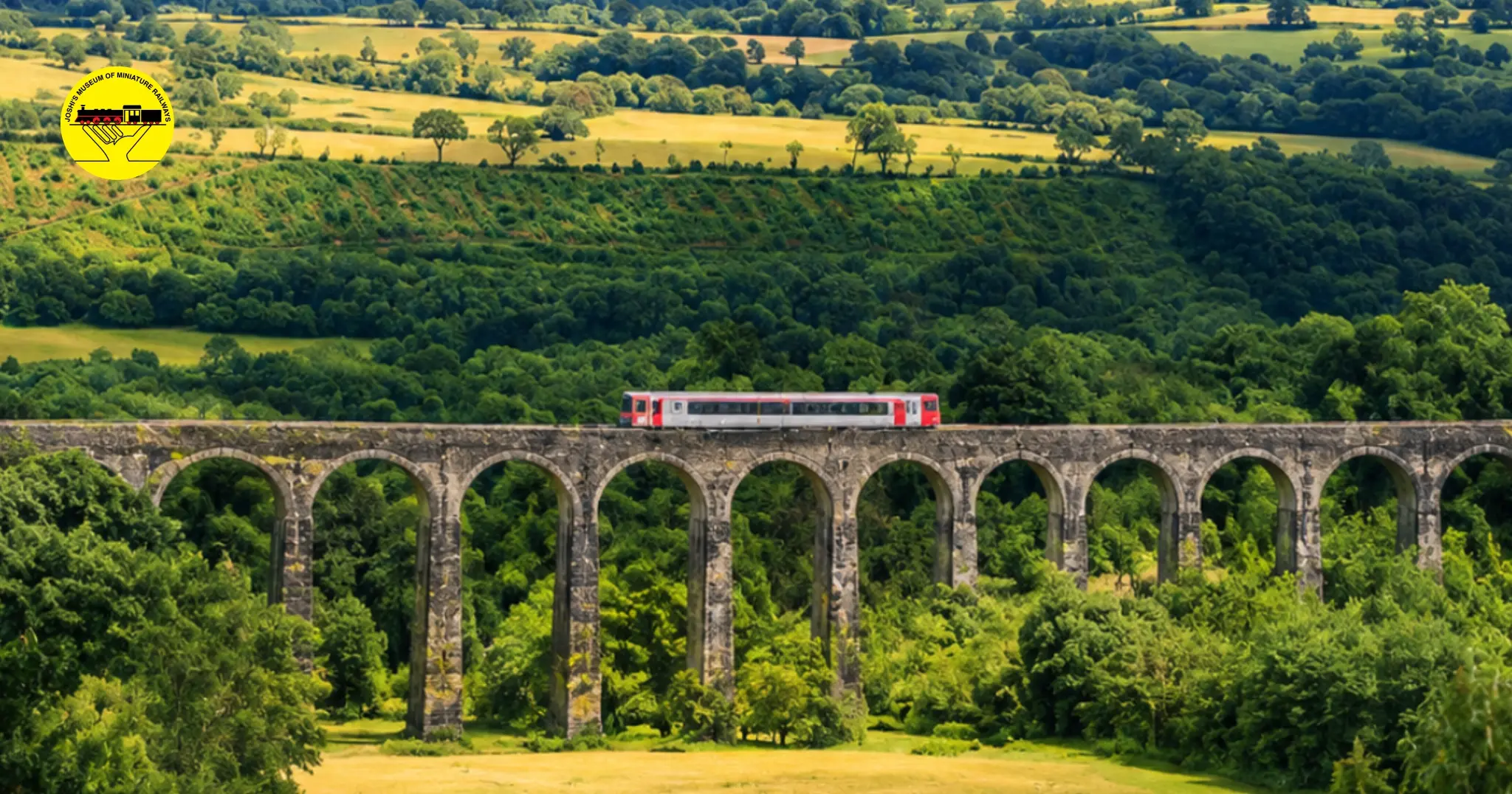
Some train journeys are about getting somewhere. Others are about watching the landscape change one window at a time.
The most scenic train routes in the world do more than connect two places. They climb mountains, cross viaducts, follow rivers, pass glaciers, curve through forests and sometimes travel through landscapes that would be difficult to experience any other way.
For railway enthusiasts, the beauty is not only outside the window. Scenic railways are also engineering stories. The more dramatic the terrain, the more interesting the railway usually becomes.
At Joshi’s Museum of Miniature Railways, that connection between landscape and railway design is something we constantly notice. A train becomes far more memorable when you understand why its route bends, climbs, tunnels or crosses a bridge.
Here are some railway journeys around the world where the route is as important as the train itself.
The Bernina Express is one of Europe’s most celebrated railway journeys, running through the Swiss Alps towards Tirano in Italy.
The route passes over 196 bridges and through 55 tunnels, travelling from high Alpine landscapes and glaciers down towards considerably warmer terrain. Parts of the Albula and Bernina railway lines are recognised as a UNESCO World Heritage Site.
One of its most famous engineering features is the way the railway gains and loses altitude without depending on a conventional rack system.
The result is a route where railway engineering seems to curve naturally into the landscape.
Despite its name, the Glacier Express is not really about speed.
The journey between Zermatt and St. Moritz takes approximately eight hours, deliberately allowing passengers to experience the Swiss Alps at a slower pace.
Along the way, the train passes through dramatic valleys, mountain landscapes and major railway structures, including the famous Landwasser Viaduct, which carries the line directly towards a tunnel entrance cut into the rock.
The section between Preda and Bergün is particularly fascinating for railway enthusiasts because a network of spiral and helical tunnels allows the train to gain hundreds of metres of elevation within a relatively compact area.
Sometimes the most scenic railway is also the one where you can actually see the engineering problem being solved.
The Flåm Railway proves that a railway does not need to be long to be extraordinary.
It travels just over 20 kilometres between Flåm and Myrdal, but climbs more than 860 metres in elevation. It is among the steepest standard-gauge railway lines in the world, with gradients reaching approximately 1 in 18.
Along the route are waterfalls, steep valley walls and mountain scenery, but the numbers behind the railway are just as impressive.
There are 20 tunnels, with 18 originally excavated largely by hand. Construction began in 1923 and the line opened in 1940.
For a railway enthusiast, Flåm is a perfect example of scenery and engineering becoming almost impossible to separate.
The West Highland Line leaves Glasgow and gradually moves into a completely different landscape.
The route towards Fort William and Mallaig passes forests, mountains, lochs and some of Scotland’s most remote scenery.
One of the most recognisable structures on the route is the Glenfinnan Viaduct, which became globally famous through its appearance in the Harry Potter films.
But the line itself is much more than a film location.
It demonstrates how railways opened connections through terrain where roads and settlements were historically sparse. Even today, the journey feels like watching the landscape become progressively more isolated.
New Zealand’s TranzAlpine crosses the South Island from Christchurch to Greymouth.
The journey starts across the relatively flat Canterbury Plains before moving into the Southern Alps, where the railway follows river gorges, crosses viaducts and cuts through mountainous terrain.
One highlight is the Staircase Viaduct, which rises about 73 metres above the stream below. The route also uses multiple tunnels and bridges to negotiate the difficult approach towards Arthur’s Pass.
The scenery changes dramatically again after crossing the Main Divide, as the railway descends towards the greener West Coast.
This is exactly the kind of journey that reminds you how much geography can change within a single train ride.
The Canadian Rockies were almost made for panoramic train windows.
The Rocky Mountaineer operates several routes through western Canada, including journeys connecting Vancouver with destinations such as Banff, Lake Louise and Jasper.
The trains travel only during daylight, specifically so passengers do not miss the landscape.
On the First Passage to the West route, the railway passes through the Fraser Valley and towards the Rockies, with landmarks including Hell’s Gate, Stoney Creek Bridge, the Spiral Tunnels and mountain scenery around Banff and Lake Louise.
It is a different kind of scenic railway experience: less about historic railway austerity and more about designing the train itself around the view.
Mexico’s Chepe Express travels through the Sierra Tarahumara and the dramatic landscape of Copper Canyon.
The journey from Los Mochis to Creel covers more than 350 kilometres and takes around nine hours. Along the way, the railway crosses bridges, passes through tunnels and climbs from lower elevations into rugged mountain country.
The scenery is spectacular, but the railway is also a major piece of mountain engineering.
For travellers, the route offers views into a region that is difficult to experience in the same way by road.
And that is one of the great strengths of scenic railways: sometimes the railway does not merely take you through the landscape. It gives you access to it.
India deserves a place on any list of the world’s most scenic train routes.
The Darjeeling Himalayan Railway, opened in 1881, runs through the Himalayan foothills of West Bengal. Its narrow-gauge track climbs using loops and zigzags that allowed engineers to overcome steep terrain without dramatically increasing the gradient.
The railway stretches for roughly 88 kilometres, passing through Ghoom at an altitude of more than 2,200 metres before reaching Darjeeling.
The scenery includes hillsides, settlements, tea-growing country and distant Himalayan views.
But what makes the journey particularly special is how closely the railway interacts with everyday life. Tracks often run beside roads, buildings and local activity.
It is not a railway separated from the landscape. It is embedded within it.
Far to the south, the Nilgiri Mountain Railway offers a completely different Indian mountain railway experience.
The metre-gauge railway climbs from approximately 326 metres to more than 2,200 metres across about 46 kilometres.
To negotiate steep gradients, part of the route uses a rack-and-pinion system, where a toothed rail between the running rails helps the train climb.
The line moves through forests, mountain slopes, bridges and tunnels on its journey towards the Nilgiri Hills.
For railway enthusiasts, it is a reminder that scenic routes are often beautiful precisely because they travel through terrain that was extremely difficult to engineer.
There is no single answer.
For some people, it is snow-covered mountains. For others, coastlines, forests or desert landscapes.
From a railway point of view, the most interesting scenic routes often share another quality: the railway has had to adapt visibly to the geography.
A spiral tunnel tells you the mountain was too steep. A high viaduct tells you the valley could not simply be crossed at ground level. A rack railway tells you ordinary wheel adhesion was not enough.
The scenery is beautiful, but the railway engineering explains how the train got there.
The most scenic train routes in the world show that railway travel can be about much more than reaching a destination.
The Bernina Express crosses Alpine landscapes. Flåm compresses an enormous change in altitude into just 20 kilometres. The TranzAlpine crosses an entire mountain range. Chepe travels through Copper Canyon, while India’s Darjeeling and Nilgiri mountain railways combine dramatic scenery with historic engineering.
Each route looks different. But all of them demonstrate the same idea: when railways meet difficult geography, the solution can become part of the attraction.
At Joshi’s Museum of Miniature Railways, that is something we appreciate at every scale.
A railway becomes much more interesting when you start looking at the world built around the track.
Popular scenic railway journeys include the Bernina Express, Glacier Express, Flåm Railway, West Highland Line, TranzAlpine, Rocky Mountaineer, Chepe Express and India’s mountain railways.
The Bernina Express travels through Switzerland’s Alpine region and continues to Tirano in Italy.
Norway’s Flåm Railway climbs more than 860 metres over roughly 20 kilometres and reaches gradients of around 1 in 18.
The Darjeeling Himalayan Railway, Nilgiri Mountain Railway and Kalka-Shimla Railway are among India’s best-known scenic railway journeys and together form the UNESCO-listed Mountain Railways of India.
Mountain railways often require unusual engineering such as loops, zigzags, viaducts, tunnels and rack systems, making the railway itself as interesting as the landscape it crosses.