High in the Swiss Alps, buried inside rock and snow, a train climbs near-vertical walls to what is known as the “Top of Europe.” This is the spectacular journey aboard the Jungfrau Railway — 9.34 kilometres of rack-rail adventure, tunnels through the Eiger and Mönch mountains, culminating at 3,454 metres above sea level. It is an engineering marvel, a tourist icon, and a symbol of mountain mastery.
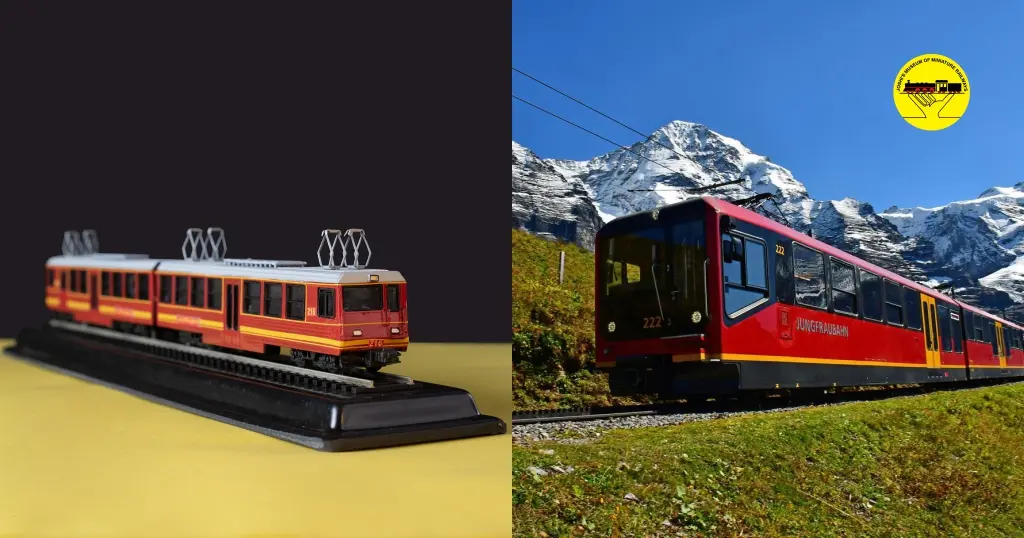
At Joshi’s Museum of Miniature Railways in Pune, we pay tribute to that giant of Alpine railroads with our very own Swiss Jungfrau Static Model.
In this blog, we explore the real Jungfrau Railway’s history, the design and technical detail behind our model, and why this Alpine legend belongs in a Pune museum.
1. The Real Journey: From Kleine Scheidegg to the Jungfraujoch
Construction of the Jungfrau Railway began in 1896, under the vision of Swiss industrialist Adolf Guyer-Zeller. His plan was bold: to build a cogwheel railway that would climb through tunnels carved inside the Eiger and Mönch mountains and end at the Jungfraujoch — the highest railway station in Europe.
The line’s challenges were immense. It has gradients up to 25 percent and tunnels that make up more than 7 kilometres of its 9.3-kilometre route, protecting it from avalanches and heavy alpine weather. The first section opened in 1903, and the complete route was inaugurated in 1912 after sixteen years of construction through snow and rock.
Riding this train is a breathtaking experience. It ascends through steep tunnels, pauses at observation windows cut into the Eiger’s northern face, and finally emerges at the summit station surrounded by glaciers and snowfields. The train’s electric traction, rack-and-pinion system, and panoramic viewing points make it one of the most admired railway experiences in the world.
2. Why We Chose the Jungfrau for Our Model
At Joshi’s Museum, our philosophy has always been that miniature railways tell stories. The Jungfrau Railway represents courage, innovation, and harmony between technology and nature — values that resonate deeply with our own work.
When we decided to recreate the Swiss Jungfrau line, we wanted to capture three key aspects:
- Technical accuracy: the steep incline, rack-rail system, and tunnel entrances.
- Visual drama: the snow-topped peaks and rugged alpine scenery.
- Symbolic meaning: the spirit of human determination that climbs literal mountains.
The result is a detailed static model designed for enthusiasts, collectors, and anyone who admires engineering excellence. It brings the scale and magic of the Alps right into Pune.
3. The Model’s Design and Build: Bringing the Alps to Pune
Building the Swiss Jungfrau model required a careful balance of artistry and precision.
a) Scale and layout
Though static, the model is built to scale, with accurately represented gradients, tunnels, and station structures. The train itself mirrors the distinctive look of the real Jungfrau carriages with panoramic windows and red-and-yellow livery.
b) Materials and finish
The terrain is built with textured mountain materials, rock-like finishes, and alpine vegetation to recreate the look of the Bernese Alps. Fine weathering effects were used to simulate wind, snow, and sun exposure on the mountain surface.
c) Rack-rail detail
The real Jungfrau line uses a rack-and-pinion system known for its steep gradients. Our model includes miniature rack detailing on the tracks, symbolizing the unique engineering principle that allows trains to climb near-vertical sections safely.
d) Storytelling elements
The model is accompanied by an information display that explains the railway’s construction history, elevation, tunnel works, and how Swiss engineers achieved such precision in early 20th-century conditions.
e) Collectible craftsmanship
The model was designed not just as a showpiece but as a collectible item for rail enthusiasts. It represents both global railway heritage and the level of detail Indian craftsmen can now achieve. You can browse it and other models in our Shop.
4. The Visitor Experience: A World Within a Display
Visitors to Joshi’s Museum often pause longest at the Swiss Jungfrau display. Its snow-covered peaks and the image of a tiny train cutting through rock evoke both wonder and peace.
Children see a storybook train conquering mountains. Engineers see the marvel of a rack-rail system that once seemed impossible. Travelers who have been to Switzerland recall the real journey and compare the miniature’s realism to their memories.
The model also serves an educational purpose. It demonstrates how trains can adapt to geography, how technology can coexist with nature, and how the human spirit builds where mountains stand in the way.
5. Why the Jungfrau Matters to Indian Rail Fans
Including the Jungfrau model in our collection is part of our broader goal: connecting India’s growing model-railway community to global icons. The Jungfrau stands for innovation — the same principle that drives India’s real and miniature railways today.
For collectors, the Swiss Jungfrau model represents the kind of craftsmanship and design India can now produce locally. It proves that we are not limited to importing European or Japanese models; we can interpret them with equal precision here in Pune.
This international approach also helps our website reach new audiences. When people around the world search for “train models” or “Jungfrau Railway model,” Joshi’s Museum becomes a point of discovery — proof that India is contributing meaningfully to the global hobby.
6. Connecting Alps and Deccan
There is a poetic link between the Swiss Alps and Pune’s Deccan hills. Both have long traditions of engineering, education, and precision craftsmanship. By recreating a piece of the Alps in miniature, we connect those two worlds — showing how imagination can bridge continents.
For Joshi’s Museum, every new model is more than a display. It’s an invitation: to learn, to collect, to appreciate how tiny details can tell the biggest stories. The Swiss Jungfrau Static Model is one such story — one that begins in snow and ends in the warm curiosity of visitors in Kothrud.
7. Visit, Explore, Collect
You can see the Swiss Jungfrau model in person at Joshi’s Museum of Miniature Railways, Paud Road, Kothrud, Pune.
To purchase or explore more collectible models, visit our Shop for Miniature Models and view the Swiss Jungfrau Static Model.
Each model is handcrafted with care, serving as a bridge between world rail heritage and India’s own miniature artistry.
8. Conclusion
From the frozen peaks of the Bernese Alps to a carefully lit display in Pune, the story of the Jungfrau Railway is one of ambition and art. The engineers who drilled through the Eiger more than a century ago could not have imagined their train inspiring miniature models halfway across the world.
Yet here it is — a train that still climbs mountains, a model that still moves hearts, and a museum that continues to connect dreamers across borders.